Tel: +86 311 8595 5658 E-mail: admin@yuanlvfilter.com
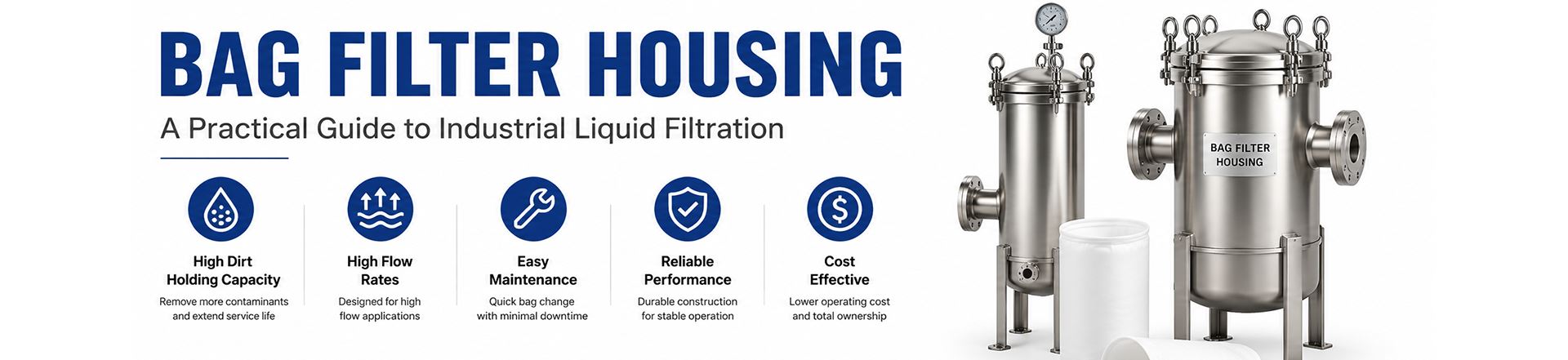
Bag filter housing is one of the most widely used solutions for industrial liquid filtration. It removes suspended solids, protects downstream equipment, and improves process reliability while maintaining high flow rates and relatively low operating costs.
From water treatment and food production to chemical processing and petrochemical plants, bag filtration systems are used wherever liquids require efficient particle removal. This guide explains how bag filter housings work, their main components, common applications, and the key factors involved in selecting the right system.
A bag filter housing is a pressure vessel designed to hold one or more filter bags that remove solid contaminants from liquids.
As liquid flows through the filter bag, particles larger than the filter media's micron rating are retained, while clean liquid exits the housing. Because filter bags provide a large filtration area and high dirt-holding capacity, bag filter housings are widely used for medium and high-flow industrial applications.
Typical benefits include:
• Cost-effective filtration
• High contaminant retention
• Simple maintenance
• Flexible micron ratings
• Reliable operation
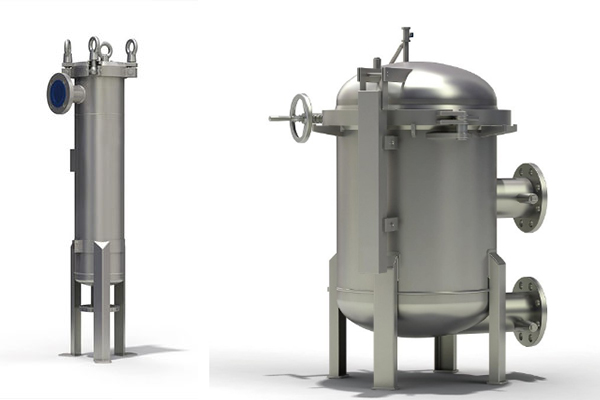
The operating principle is straightforward:
Step 1: Liquid Enters the Housing
Contaminated liquid enters through the inlet connection.
Step 2: Filtration Occurs
The liquid passes through the filter bag supported by an internal basket. Suspended solids are captured by the filter media.
Step 3: Clean Liquid Exits
Filtered liquid flows through the outlet and returns to the process system.
Step 4: Filter Bag Replacement
As contaminants accumulate, differential pressure increases. The filter bag is replaced when it reaches its service limit.
Common contaminants removed include:
• Sand
• Rust
• Scale
• Fibers
• Process debris
• Undissolved solids
Bag filtration remains popular because it offers a balance between filtration performance and operating cost.
• High Dirt-Holding Capacity
Filter bags can retain a large volume of contaminants before replacement is required.
• Suitable for High Flow Rates
Bag filter housings can process significant liquid volumes while maintaining low pressure loss.
• Lower Operating Costs
Filter bags are generally economical and easy to replace.
• Easy Maintenance
Routine servicing usually requires only filter bag replacement.
• Flexible Filtration Options
A wide range of micron ratings and filter media are available for different applications.
1. Housing Vessel
The pressure vessel contains the filtration process and withstands operating conditions.
Common materials include:
• Stainless Steel 304
• Stainless Steel 316L
• Carbon Steel
• Duplex Stainless Steel
2. Filter Bag
Selecting the correct filter bag size is also an important consideration when configuring an industrial bag filter housing system. The filter bag performs the particle separation.
The filter bag is the primary filtration element and determines filtration efficiency. Different micron ratings affect particle retention, pressure drop, and service life. Learn more about filter bag micron rating selection.
Common filter media include:
• Polypropylene (PP)
• Polyester (PE)
• Nylon Mesh
• PTFE
• Stainless Steel Mesh
3. Internal Support Basket
The basket supports the filter bag and prevents collapse under pressure.
4. Closure System
The cover and sealing system provide leak-free operation and easy maintenance access.
5. Pressure Monitoring
Pressure gauges help operators identify when filter bags should be replaced.
In-depth Reading: Bag Filter Housing Components
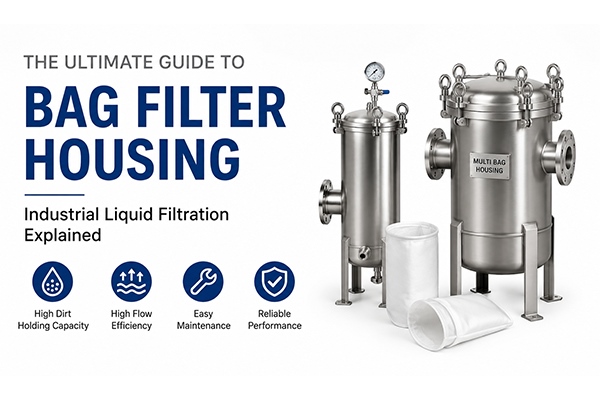
Choosing between single bag and multi bag systems depends primarily on flow rate and operating requirements.
Single bag housings contain one filter bag and are commonly used for:
Small process systems
Utility water filtration
Pilot plants
Batch production
Advantages:
Compact design
Lower investment cost
Simple maintenance
Multi bag housings contain multiple filter bags operating within a single vessel.
Advantages:
Higher flow capacity
Longer service intervals
Reduced maintenance frequency
Improved productivity
These systems are widely used in continuous industrial operations.
Comparison
| Feature | Single Bag Housing | Multi Bag Housing |
|---|---|---|
| Flow Capacity | Low to Medium | Medium to High |
| Installation Space | Smaller | Larger |
| Initial Cost | Lower | Higher |
| Maintenance Frequency | Higher | Lower |
| Best For | Small Systems | Large Systems |
In-depth Reading:
Single Bag Filter Housing vs Multi Bag Filter Housing
Top Entry vs Side Entry Bag Filter Housing
Material selection directly affects equipment life and process reliability.
| Material | Corrosion Resistance | Typical Applications |
|---|---|---|
| SS304 | Good | Water Treatment, Utility Systems |
| SS316L | Excellent | Food, Beverage, Pharmaceutical |
| Carbon Steel | Moderate | Non-Corrosive Liquids |
| Duplex SS | Outstanding | Seawater, Chemical Processing |
When selecting materials, always consider chemical compatibility, temperature, pressure, and industry requirements. Learn more about bag filter housing material selection.
Bag filter housings are used across a wide range of industries.
| Industry | Typical Application |
|---|---|
| Water Treatment | Sediment and suspended solids removal |
| Food & Beverage | Syrup, edible oil, and beverage filtration |
| Chemical Processing | Process liquid filtration |
| Paint & Coatings | Removal of particles and agglomerates |
| Pharmaceutical | Pre-filtration of process liquids |
| Petrochemical | Lubricants, fuels, and chemical filtration |
In many facilities, bag filtration serves as the first stage of a multi-step filtration system.
Explore bag filter housing applications in water treatment systems.
Selecting the right system begins with understanding the operating conditions.
1. Determine Flow Rate
Flow rate is the primary factor in selecting housing size and deciding between single or multi bag configurations.
2. Define Filtration Precision
Choose the micron rating required to achieve the desired filtration performance.
3. Evaluate Fluid Characteristics
Consider:
Viscosity
Solids concentration
Chemical composition
Corrosiveness
4. Verify Operating Pressure and Temperature
Ensure the housing design matches actual operating conditions.
5. Select Compatible Materials
The housing, basket, seals, and filter media should all be compatible with the process fluid.
6. Consider Future Expansion
A scalable design can accommodate future production increases without major system modifications.
Click here to learn more: Step-by-Step to Choose the Right Bag Filter Housing
Before selecting a system, gather the following information:
| Parameter | Information Required |
|---|---|
| Flow Rate | m³/h or GPM |
| Filtration Precision | Micron Rating |
| Fluid Type | Water, Oil, Chemical, Food Product |
| Operating Pressure | Bar or PSI |
| Operating Temperature | °C or °F |
| Housing Material | SS304, SS316L, Carbon Steel, Duplex |
| Connection Type | Flange, Thread, Clamp |
| Installation Space | Available Footprint |
This information helps ensure proper system sizing and long-term reliability.
Selecting the right housing design is only the first step. Proper bag filter housing maintenance practices are also important for maintaining stable filtration performance during long-term operation. In addition to proper maintenance, bag filter housing troubleshooting is also crucial.
1. Choosing an Overly Fine Micron Rating
Smaller micron ratings can increase pressure drop and operating costs.
2. Ignoring Chemical Compatibility
Incorrect material selection may cause corrosion or premature equipment failure.
3. Underestimating Flow Requirements
An undersized housing often results in excessive pressure loss.
4. Focusing Only on Initial Cost
Long-term operating costs are often more important than initial purchase price.
5. Overlooking Maintenance Access
Poor accessibility can significantly increase service time and labor costs.
Both technologies are commonly used in industrial filtration, but their applications differ.
| Feature | Bag Filter Housing | Cartridge Filter Housing |
|---|---|---|
| Flow Rate | High | Medium |
| Dirt Holding Capacity | High | Moderate |
| Filtration Accuracy | 1–800 μm | 0.1–100 μm |
| Replacement Frequency | Lower | Higher |
| Operating Cost | Lower for High Solids | Higher for High Solids |
| Best Application | Pretreatment & Bulk Filtration | Fine & Final Filtration |
In many systems, bag filtration is installed upstream of cartridge filtration to reduce cartridge replacement frequency and overall operating costs.
1. What is a bag filter housing used for?
It removes suspended solids and particulate contaminants from liquid streams.
2. What micron ratings are available?
Most industrial filter bags are available from 1 to 800 microns.
3. What is the difference between single bag and multi bag housings?
Single bag housings contain one filter bag, while multi bag housings contain multiple bags and support higher flow rates.
4. Which material is best for corrosive liquids?
SS316L and duplex stainless steel are commonly used for corrosive applications.
5. Can bag filter housings be customized?
Yes. Manufacturers can provide custom dimensions, materials, connection types, and pressure ratings.
Projects with unique flow rates, pressure requirements, flange standards, or installation constraints may require a customized solution. Learn more in our Custom Bag Filter Housing Solutions guide.
Bag filter housings remain one of the most practical and economical solutions for industrial liquid filtration. Their high flow capacity, large contaminant-holding capability, and flexible design make them suitable for applications ranging from water treatment to chemical processing.
By understanding filtration requirements, material compatibility, and operating conditions, engineers and purchasing professionals can select a system that delivers reliable performance, lower maintenance costs, and long service life.