Tel: +86 311 8595 5658 E-mail: admin@yuanlvfilter.com
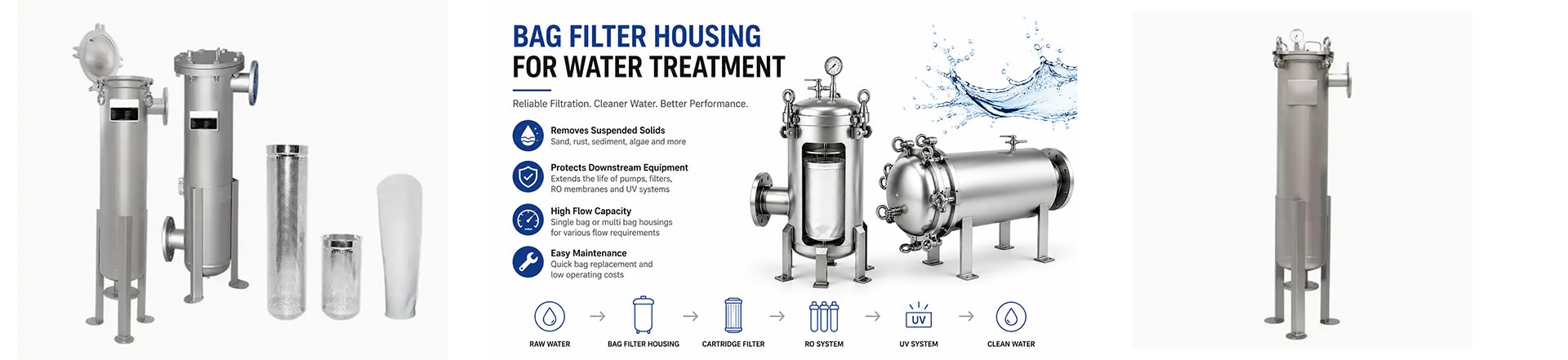
A bag filter housing is widely used in water treatment systems to remove suspended solids, sand, rust, algae, and other particulate contaminants before water reaches downstream equipment such as cartridge filters, reverse osmosis (RO) membranes, UV sterilizers, or process equipment. Selecting the right housing depends on water quality, flow rate, filtration accuracy, operating pressure, and maintenance requirements.
For a broader overview of bag filtration systems, see our Industrial Bag Filter Housing Guide.
Water treatment systems often process large volumes of raw or recycled water containing suspended particles. If these contaminants are not removed at an early stage, they can clog downstream equipment, increase maintenance frequency, and reduce overall system efficiency.
Installing a bag filter housing as a pre-filtration stage helps:
• Remove coarse and medium-sized suspended solids
• Protect pumps, valves, and pipelines
• Extend the service life of cartridge filters and RO membranes
• Reduce equipment fouling and maintenance costs
• Improve overall system reliability
For many industrial water treatment systems, bag filtration provides an effective balance between filtration performance and operating cost.
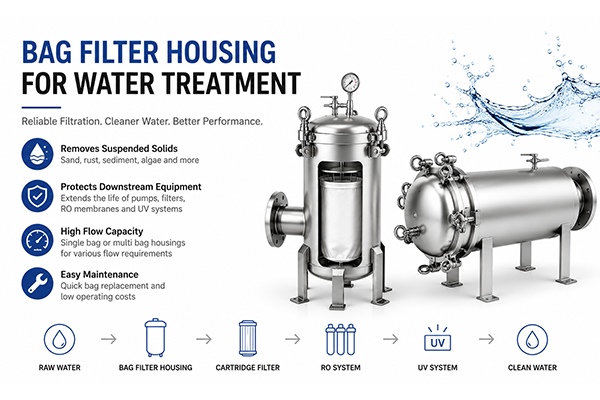
The installation position depends on the treatment process, but bag filter housings are most commonly used as pre-filtration equipment.
A typical process is:
Raw Water → Bag Filter Housing → Cartridge Filter → RO System / UV System → Clean Water Storage
In this position, the bag filter removes larger particles before fine filtration equipment, helping reduce pressure drop and extending the operating life of downstream components.
The contaminants removed depend on the selected filter bag micron rating, but common applications include:
| Contaminant | Typical Source |
|---|---|
| Sand | Groundwater and well water |
| Rust particles | Aging pipelines and storage tanks |
| Sediment | Rivers, lakes, and raw water |
| Algae | Surface water systems |
| Scale particles | Cooling and circulating water |
| Organic debris | Open water intake systems |
Bag filtration is designed to remove solid particles, not dissolved substances or microorganisms.
Selecting the appropriate filter bag is just as important as selecting the housing.
| Water Treatment Application | Typical Micron Rating |
|---|---|
| Raw water pre-filtration | 100–200 μm |
| Cooling water | 50–100 μm |
| General process water | 25–50 μm |
| RO membrane pre-filtration | 5–10 μm |
| Fine polishing filtration | 1–5 μm |
The ideal micron rating depends on both the contaminant size and the protection required for downstream equipment.
Related Reading: Filter Bag Micron Ratings Explained
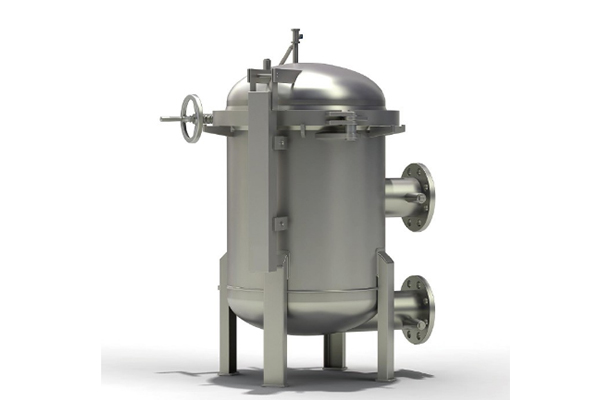
Several process conditions should be evaluated before selecting a housing.
1. Flow Rate
Flow rate determines the required filtration area. Smaller systems generally use single bag filter housings, while higher flow applications often require multi bag filter housings.
2. Water Quality
Higher levels of suspended solids may require larger filtration capacity or more frequent bag replacement.
3. Operating Pressure
The housing pressure rating should always exceed the system's normal operating pressure and include an appropriate safety margin.
4. Housing Material
Stainless steel is commonly used for municipal and industrial water treatment.
Carbon steel may be suitable for non-corrosive applications where cost is a priority.
Related Reading: How to Choose a Bag Filter Housing
Bag filter housings are widely used in various water treatment processes, including:
• Municipal water treatment
• Groundwater treatment
• Surface water filtration
• Cooling water systems
• Boiler feed water pretreatment
• Reverse osmosis (RO) pretreatment
• Wastewater recycling
• Industrial process water
• Irrigation water filtration
Although the operating conditions differ, the goal remains the same—protect downstream equipment while maintaining stable filtration performance.
The choice depends primarily on system flow rate and maintenance requirements.
A single bag housing is often suitable for lower flow applications or systems with limited installation space. Multi bag housings provide greater filtration capacity and longer operating cycles, making them more suitable for continuous industrial processes.
Related Reading: Single Bag Filter Housing vs Multi Bag Filter Housing
Both configurations are widely used in water treatment systems.
Top entry housings generally offer improved sealing performance and are preferred where filtration integrity is critical. Side entry housings provide a compact and economical solution for many standard water treatment applications.
Related Reading: Top Entry vs Side Entry Bag Filter Housing
Every water treatment system has different operating conditions. Standard equipment may not always provide the best solution.
At YuanLv, we provide customized bag filter housing solutions based on project requirements, including:
• Single or multi bag configurations
• Stainless steel or carbon steel construction
• Custom inlet and outlet connections
• Pressure rating customization
• Vertical or horizontal installation
• Duplex and skid-mounted filtration systems
Custom engineering helps ensure the filtration system integrates efficiently with existing process equipment while reducing installation and maintenance challenges.
1. Can a bag filter housing remove bacteria?
No. A bag filter housing removes suspended solid particles. Bacteria and dissolved contaminants usually require membrane filtration, UV disinfection, or other water treatment technologies.
2. Can a bag filter housing protect RO membranes?
Yes. Installing a bag filter housing before an RO system helps reduce suspended solids and extends membrane service life by lowering the particle load.
3. Is stainless steel suitable for water treatment?
Yes. Stainless steel is widely used because of its corrosion resistance, durability, and long service life in most industrial and municipal water treatment systems.
Bag filter housings are an effective pre-filtration solution for water treatment systems, helping remove suspended solids and protect downstream equipment. Selecting the right housing based on flow rate, water quality, filtration requirements, and operating conditions improves system reliability while reducing maintenance costs.