Tel: +86 311 8595 5658 E-mail: admin@yuanlvfilter.com
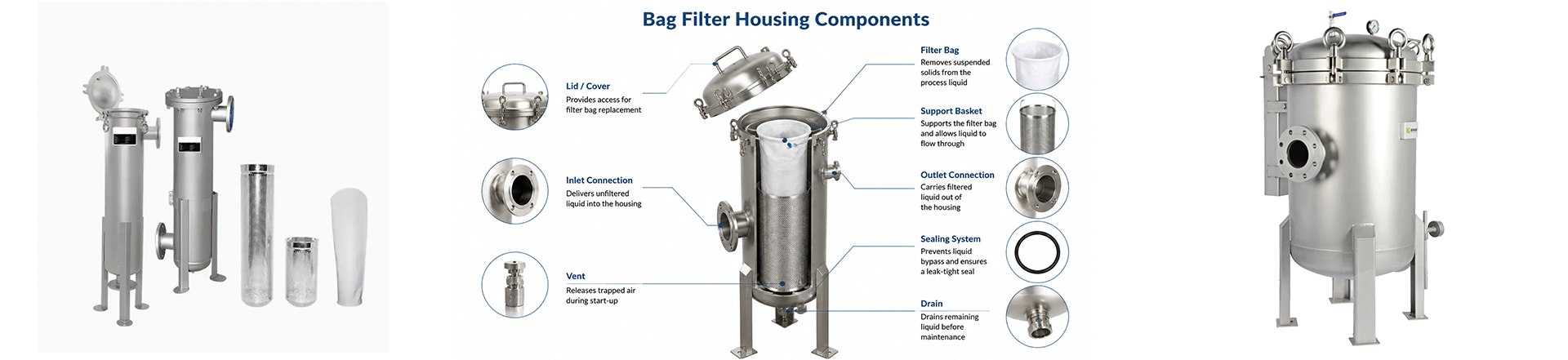
A bag filter housing is a pressure filtration system where each component affects sealing performance, pressure resistance, flow distribution, and maintenance efficiency.
The filter bag performs particle separation, while the housing structure, support basket, closure system, and connections ensure stable operation under industrial conditions.
For this reason, selecting a bag filter housing requires more than choosing a filter bag size. The internal structure and design details must match the operating pressure, fluid characteristics, and maintenance requirements.
For a broader understanding of industrial bag filtration equipment, readers can also explore our Industrial Bag Filter Housing Guide.
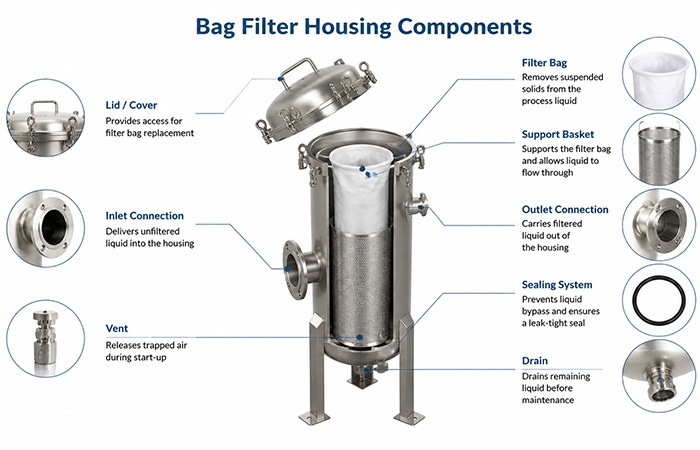
Bag filter housings with similar external dimensions may differ significantly in long-term performance. The strength of the support basket, the quality of the sealing surface, and the accuracy of vessel fabrication all influence equipment reliability.
Good component design helps maintain stable flow, reduces the possibility of liquid bypass, and simplifies routine maintenance throughout the service life of the equipment.
The pressure vessel forms the main body of the filter housing. It withstands system pressure while protecting the internal filtration components.
Industrial housings are commonly manufactured from stainless steel because of its corrosion resistance, mechanical strength, and suitability for a wide range of process fluids.
The housing material and wall thickness are selected according to operating pressure, fluid characteristics, and corrosion requirements.
The pressure vessel and internal components are commonly manufactured from stainless steel or carbon steel depending on corrosion requirements and operating conditions. More details about material selection can be found in our bag filter housing material selection guide.
The support basket is the structural foundation of the filter bag.
During operation, differential pressure causes the filter bag to expand against the basket. A rigid basket prevents deformation, supports the full filtration area, and allows liquid to flow evenly across the filter media.
Basket design also influences pressure loss. Sufficient open area helps maintain flow while reducing unnecessary resistance.
The support basket prevents filter bag collapse under differential pressure and maintains proper flow through the filtration area.
The filter bag is the replaceable filtration element that removes suspended solids from the process liquid.
Once the bag reaches its dirt-holding capacity, it can be replaced without removing the housing from the pipeline.
Related Article: Filter Bag Micron Ratings Explained
The lid closes the pressure vessel during operation and provides access for filter bag replacement.
Many industrial housings use swing bolts or quick-opening covers to shorten maintenance time and improve operator convenience.
The sealing system creates a leak-tight connection between the filter bag and the housing.
A properly installed seal forces all process liquid to pass through the filter media. Damaged or incompatible seals may allow unfiltered liquid to bypass the filter bag, reducing filtration efficiency.
In-depth Reading: common bag filter housing problems
The inlet delivers unfiltered liquid into the housing, while the outlet carries filtered liquid back into the process.
Connection standards, sizes, and orientations should match the piping system and operating requirements.
Related Article: Top Entry vs Side Entry Bag Filter Housing
The vent releases trapped air during start-up, helping the housing fill completely with liquid.
The drain allows the remaining liquid to be discharged before maintenance, making filter bag replacement safer and cleaner.
Although simple, both components improve day-to-day operation.
| Component | Primary Function | Design Impact |
|---|---|---|
| Hosing | Contains operating pressure | Pressure resistance and durability |
| Support Basket | Supports the filter bag | Filter bag support and flow stability |
| Filter Bag | Removes suspended solids | -- |
| Lid / Cover | Provides maintenance access | -- |
| Sealing System | Prevents liquid bypass | Leakage prevention |
| Inlet & Outlet | Controls process flow | -- |
| Vent | Releases trapped air | -- |
| Drain | Drains remaining liquid | -- |
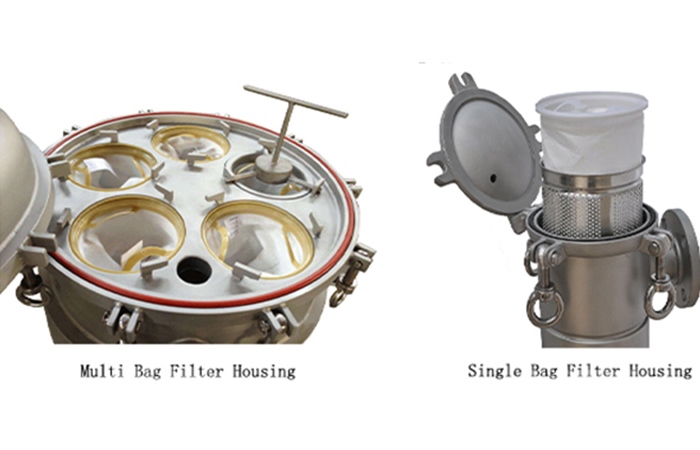
Each component performs a specific task during filtration.
The pressure vessel contains the operating pressure. The inlet directs liquid into the housing, where the support basket holds the filter bag in position. As liquid passes through the filter media, suspended particles remain inside the bag while clean liquid exits through the outlet. Throughout the process, the sealing system prevents bypass, ensuring that all liquid flows through the filter bag rather than around it.
This coordinated design allows the housing to maintain stable filtration under continuous operating conditions.
Not every component affects filtration in the same way.
The filter bag determines particle retention.
The support basket maintains bag stability and influences flow distribution.
The sealing system prevents bypass between the bag and the housing.
Together, these three components have the greatest impact on filtration quality. Other components mainly contribute to structural strength, pressure containment, and maintenance efficiency.
Regular inspection of these parts is an important part of industrial bag filter housing maintenance.
Component selection should match the operating conditions of the filtration system.
Higher operating pressure requires a stronger vessel construction.
Corrosive liquids may require upgraded stainless steel materials.
Applications with frequent filter bag replacement benefit from quick-opening covers.
Large flow systems require support baskets with sufficient open area to maintain stable flow while minimizing pressure drop.
Rather than changing the filtration principle, these design details improve equipment durability and simplify maintenance.
Standard configurations meet the needs of many applications, but customized component designs are often required for specialized operating conditions.
YuanLv provides customization options including:
• Housing material
• Pressure rating
• Connection standard
• Support basket design
• Surface finish
• OEM manufacturing according to project specifications
Component customization helps ensure compatibility with existing process systems while meeting specific operating requirements.
Component quality is determined not only by material selection but also by manufacturing accuracy.
For example, the dimensional accuracy of the support basket affects how well the filter bag fits inside the housing. Precision-machined sealing surfaces improve sealing performance, while consistent welding quality contributes to long-term structural reliability.
Although these details are not immediately visible after installation, they influence equipment performance throughout its service life.
1. Which component supports the filter bag?
The support basket supports the filter bag during operation and prevents deformation caused by differential pressure.
2. Why is the sealing system important?
The sealing system prevents unfiltered liquid from bypassing the filter bag, ensuring effective filtration.
3. Can individual components be replaced?
Yes. Filter bags, support baskets, seals, vents, and drains can generally be serviced or replaced without replacing the complete housing.
4. Is stainless steel always the preferred housing material?
Stainless steel is widely used because of its corrosion resistance and durability, but material selection should always match the process conditions.
A bag filter housing is more than a pressure vessel containing a filter bag. Each component contributes to the overall performance of the filtration system, from supporting the filter media and controlling liquid flow to maintaining reliable sealing and simplifying maintenance. Evaluating component design alongside basic specifications provides a more complete understanding of equipment quality and long-term operating reliability.