Tel: +86 311 8595 5658 E-mail: admin@yuanlvfilter.com
The choice between Stainless Steel 304 and 316L wedge wire screens depends mainly on the operating environment. 304 stainless steel is a cost-effective and reliable option for general filtration and non-corrosive environments. In contrast, 316L stainless steel is the preferred material for marine, chemical, or high-chloride conditions where maximum corrosion resistance and long service life are required.
Selecting the correct material is critical for industrial filtration systems because it directly affects durability, corrosion resistance, maintenance costs, and operational reliability.
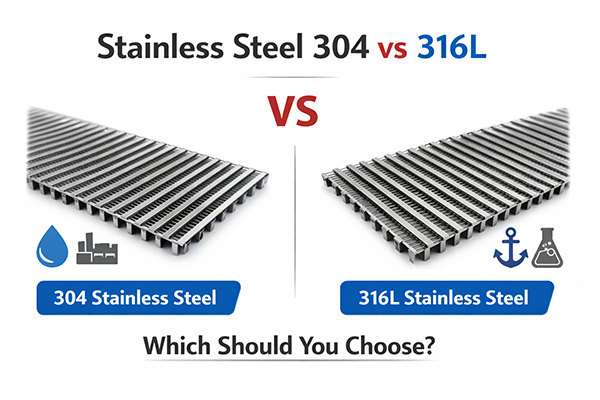
Wedge wire screens are widely used in water treatment, food processing, mining, petrochemical filtration, and wastewater treatment. These systems often operate in demanding environments that expose metal components to:
• Chlorides and saltwater
• Chemical solutions and acids
• High temperatures or pressure
• Continuous flow and mechanical stress
Because the screen surface is constantly in contact with process media, the stainless steel grade used in fabrication strongly influences:
• Corrosion resistance
• Structural integrity
• Welding performance
• Service life
Choosing the correct material helps prevent premature corrosion, screen failure, and costly downtime.
The primary differences between these two stainless steel grades lie in their chemical composition and corrosion resistance.
| Property | 304 Stainless Steel | 316L Stainless Steel |
|---|---|---|
| Chromium | ~18% | 16–18% |
| Nickel | ~8% | 10–14% |
| Molybdenum | None | 2–3% |
| Carbon Content | ≤0.08% | ≤0.03% |
| Corrosion Resistance | Good | Excellent |
| Cost | Lower | 15–40% higher |
| Typical Environment | Freshwater, indoor industrial | Marine, chemical, salt exposure |
The most important difference is the addition of molybdenum in 316L, which significantly improves resistance to chloride corrosion and aggressive chemicals.
For wedge wire screens, corrosion resistance is usually the deciding factor.
✔ Stainless Steel 304
304 stainless steel performs well in most general industrial environments. It is commonly used in:
• Drinking water filtration
• Food processing equipment
• Indoor industrial filtration systems
• Municipal wastewater treatment
However, it can experience pitting or crevice corrosion when exposed to chlorides or saltwater.
✔ Stainless Steel 316L
316L contains 2-3% molybdenum, which significantly improves resistance to:
• Saltwater and marine environments
• Chlorinated water
• Chemical processing fluids
• Coastal industrial facilities
This makes 316L the preferred material for seawater intake screens, desalination plants, and chemical filtration systems.

Wedge wire screens are manufactured through precision resistance welding, where profile wires are welded to support rods.
The low carbon content of 316L provides an important advantage during fabrication.
✔ 304 Stainless Steel
• Good weldability
• Possible risk of sensitization if exposed to high heat
• Slight reduction in corrosion resistance around weld zones
✔ 316L Stainless Steel
• Excellent weldability
• Low carbon reduces risk of intergranular corrosion
• Better performance in heavily welded structures
Because wedge wire screens often involve numerous weld points, 316L offers greater long-term stability in corrosive environments.
Both stainless steel grades provide strong mechanical properties suitable for industrial filtration equipment.
However, 316L generally performs better under demanding operating conditions, including:
• Higher temperatures
• Continuous industrial operation
• Chemical exposure
For heavy-duty filtration systems, such as mining slurry screens or chemical reactor support grids, the improved durability of 316L may justify its higher cost.
Budget is always an important factor in industrial equipment selection.
304 stainless steel is more economical because it does not contain molybdenum.
316L stainless steel typically costs 15-40% more, depending on market conditions and raw material prices.
However, lifecycle cost should be considered rather than just the initial purchase price.
In highly corrosive environments, 316L can deliver:
• Longer service life
• Reduced maintenance
• Lower replacement frequency
This often results in lower total operating costs over time.
When to Choose 304 Wedge Wire Screens
304 stainless steel is suitable for:
• Freshwater filtration systems
• Food and beverage processing (non-saline environments)
• Industrial water treatment plants
• Agricultural irrigation filtration
• Indoor filtration equipment
When to Choose 316L Wedge Wire Screens
316L is recommended for:
• Seawater intake systems
• Desalination plants
• Chemical processing facilities
• Coastal industrial installations
• Swimming pool or chlorinated water filtration
In these environments, the enhanced corrosion resistance of 316L significantly improves reliability.
Engineers often use the following simplified rule:
Use 304 stainless steel for general industrial filtration.
Use 316L stainless steel whenever chlorides, saltwater, or aggressive chemicals are present.
If the installation site is near the ocean or exposed to salt, choosing 316L is usually the safer long-term decision.
Frequently Asked Questions
1. Is 316L always better than 304 for wedge wire screens?
Not necessarily. 316L offers better corrosion resistance, but 304 is sufficient for many general filtration applications where chloride exposure is minimal.
2. Why is 316L stainless steel more corrosion resistant?
316L contains molybdenum, which significantly improves resistance to chloride corrosion, pitting, and chemical attack.
3. Can 304 stainless steel be used in water treatment?
Yes. 304 stainless steel is widely used in freshwater filtration systems, municipal water treatment, and industrial water filtration.
4. How much more expensive is 316L stainless steel?
316L stainless steel typically costs 15–40% more than 304, depending on material prices and manufacturing specifications.
Choosing between 304 and 316L stainless steel wedge wire screens ultimately depends on environmental conditions, corrosion exposure, and project budget.
304 stainless steel offers an economical and reliable solution for most general filtration systems.
316L stainless steel provides superior corrosion resistance and longer service life in marine, chemical, or high-chloride environments.
For critical filtration systems where durability and reliability are essential, investing in the correct material can significantly improve system performance, lifespan, and total operational efficiency.