Tel: +86 311 8595 5658 E-mail: admin@yuanlvfilter.com
A hydrosieve screen should be designed based on flow rate, slot size, screen width, and installation angle, as these parameters directly determine separation efficiency and operational stability. Proper design ensures consistent performance, low maintenance, and long service life in wastewater treatment systems.
Hydrosieve screen design is the process of selecting the appropriate geometry, material, and operating parameters to achieve efficient solid–liquid separation under gravity-flow conditions.
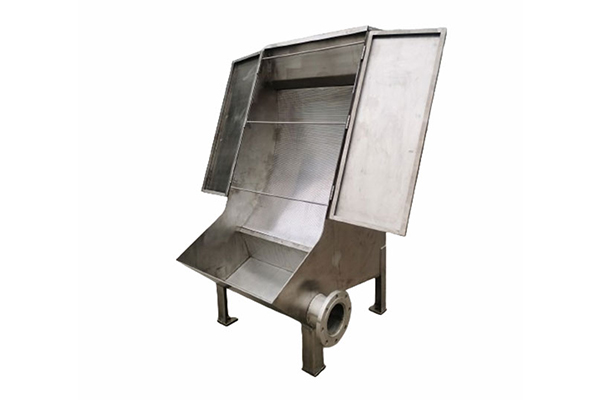
A typical hydrosieve consists of:
• A curved wedge wire screen panel
• An inlet distribution system
• A supporting frame or housing
• A solids discharge section
The performance of the system depends on how well these elements are matched to the application.
For a complete guide, visit our hydrosieve screen overview
Slot size determines the smallest particle that can be retained by the screen.
Typical ranges:
• 0.25 mm → fine filtration
• 0.5 mm → municipal wastewater
• 1.0 mm or larger → coarse separation
Design principle:
Slot size should be slightly smaller than the target particle size, while still allowing stable flow without clogging.
In-Depth Reading → Hydrosieve Screens Slot Size Choose Guide
The flow rate must match the screen's capacity to avoid overflow or reduced efficiency.
Considerations:
• Peak vs average flow
• Solids concentration
• Liquid viscosity
Best practice:
Design for peak flow conditions with a safety margin to ensure stable operation.
The effective screening area determines how much water can be processed.
Key factors:
• Wider screens handle higher flow rates
• Larger surface area improves separation efficiency
• Undersized screens lead to overloading and clogging
Hydrosieve screens are typically installed at an angle to allow gravity-driven solids discharge.
Common range:
35° to 60°
Design impact:
• Steeper angles improve solids movement
• Shallower angles increase contact time
Material choice affects durability, corrosion resistance, and lifespan.
Common materials:
• SS304 → general wastewater applications
• SS316L → corrosive or high-salinity environments
For abrasive conditions, higher-grade materials or surface treatments may be required.
Uniform flow distribution is critical for consistent performance.
Poor distribution can cause:
• Uneven loading
• Local clogging
• Reduced efficiency
Best practice:
Use a well-designed inlet weir or distributor to ensure even flow across the screen width.
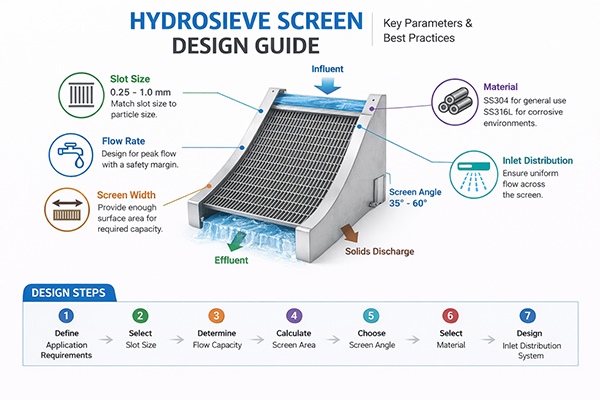
Designing a hydrosieve screen typically follows these steps:
1. Define application requirements
(wastewater type, solids content, flow rate)
2. Select slot size
based on particle size and filtration needs
3. Determine flow capacity
including peak load conditions
4. Calculate required screen area
based on hydraulic load
5. Choose screen angle and configuration
6. Select material
based on corrosion and wear conditions
7. Design inlet distribution system
for uniform flow
An incorrect design can lead to several operational issues:
• Frequent clogging
• Reduced treatment efficiency
• Uneven flow distribution
• Increased maintenance costs
In contrast, a properly designed hydrosieve screen provides:
• Stable separation performance
• Lower operational costs
• Longer service life
• Minimal maintenance
• Using Incorrect Slot Size
Slots that are too small may clog easily, while slots that are too large reduce filtration efficiency.
• Ignoring Peak Flow Conditions
Designing only for average flow can result in overflow during peak operation.
• Poor Flow Distribution
Without proper inlet design, even a high-quality screen cannot perform efficiently.
• Undersized Screen Area
Insufficient screening area leads to overloading and rapid performance decline.
1. What slot size is best for hydrosieve screens?
For most municipal wastewater applications, 0.5 mm is commonly used, but the optimal size depends on particle characteristics and flow conditions.
2. How do I calculate hydrosieve capacity?
Capacity depends on screen area, slot size, and hydraulic load.
3. What angle should a hydrosieve screen be installed at?
Most systems use an angle between 35° and 60°, depending on solids characteristics and discharge requirements.
4. What material should I choose?
SS304 is suitable for general use, while SS316L is recommended for corrosive environments.
Hydrosieve design depends on slot size, flow rate, screen area, and angle
Proper inlet distribution is essential for uniform performance
Incorrect design leads to clogging and efficiency loss
Matching design parameters to real operating conditions is critical
Hydrosieve screen design is not only about selecting a screen panel but about optimizing the entire system for the specific application. By carefully considering slot size, flow conditions, screen geometry, and material selection, engineers can achieve efficient and reliable solid–liquid separation.
A well-designed hydrosieve system delivers consistent performance, reduces maintenance, and ensures long-term operational stability in wastewater treatment and industrial filtration processes.