Tel: +86 311 8595 5658 E-mail: admin@yuanlvfilter.com
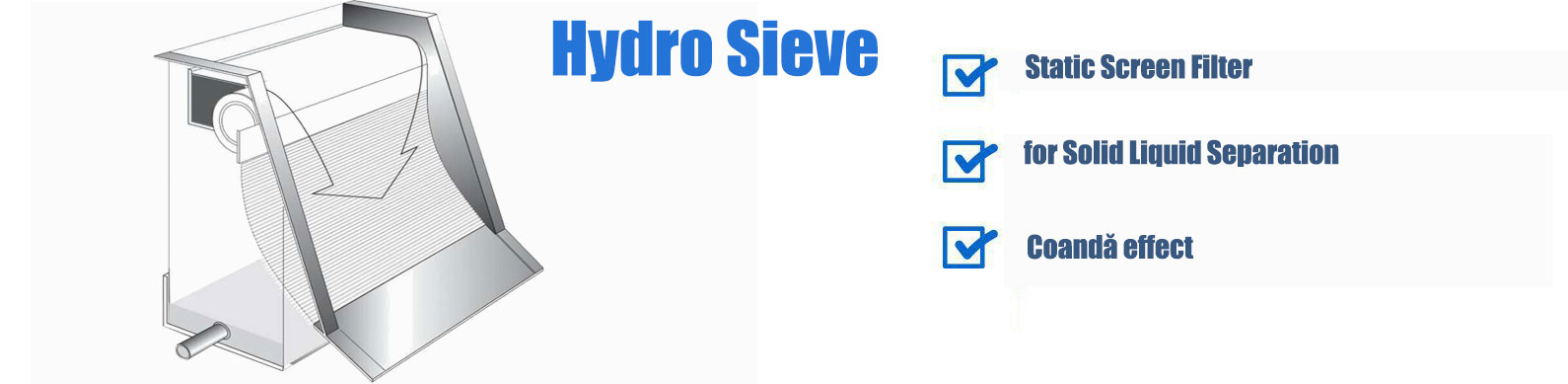
A hydrosieve screen is a cost-effective and efficient sieve used for separating solids from liquids. It utilizes a durable stainless steel bar screen with a triangular cross-section, also known as a waterfall sieve. The velocity of the incoming liquid is used to separate the solids. Its effectiveness has been proven through numerous installations worldwide across various applications.
Key Characteristics:
• No moving parts (static operation)
• Gravity-driven filtration
• Wedge wire anti-clogging surface
• Continuous operation
The operating principle of the hydro sieve relies on the Coandă effect, where the liquid forms a hydraulic attachment to the bars of the screen plate. Unlike straight bars, these bars have rounded angles and are configured in a wavy pattern. As a result, the liquid passes through slots while the separated solids remain on the front face of the screen plate. The screen plate is designed with three distinct angles to ensure efficient elimination of liquid, deceleration of screenings, and drainage.
To support this screen plate, there is a frame that promotes even distribution of effluent across its width before accelerating it down the screen plate. The filtered liquid is collected in the base beneath the screen plate. Together, these components form what is known as Hydro Sieve.
The operation is based on gravity flow and surface filtration:
• Liquid flows onto the screen surface
• Water passes through wedge wire slots
• Solids remain on the surface
• Solids slide downward due to gravity
In advanced designs, the Coanda effect improves flow distribution and enhances separation efficiency.
| Feature | Hydrosieve Screen | Rotary Drum Screen |
|---|---|---|
| Energy consumption | None | High |
| Moving parts | No | Yes |
| Maintenance | Low | High |
| Clogging resistance | High | Medium |
| Operating cost | Low | High |
Hydrosieve screens are ideal for low-energy, high-solids filtration, while rotary drum screens suit automated mechanical systems.
Related News:
DSM Screen vs Rotary Drum Screen
Hydro Sieve vs Sieve Bend Screen
No moving parts or motor is required.
Low installation costs with minimal maintenance needed.
Only periodic cleaning is necessary.
Quiet operation.
The wave shape of the bars facilitates a self-cleaning effect for Hydra Sieve's longevity.
In conclusion, hydro sieves provide an economical solution for solid/liquid separation by efficiently utilizing water flow velocity without complex machinery or high maintenance requirements.
Maintain details → How to Maintain a Hydrosieve Screen
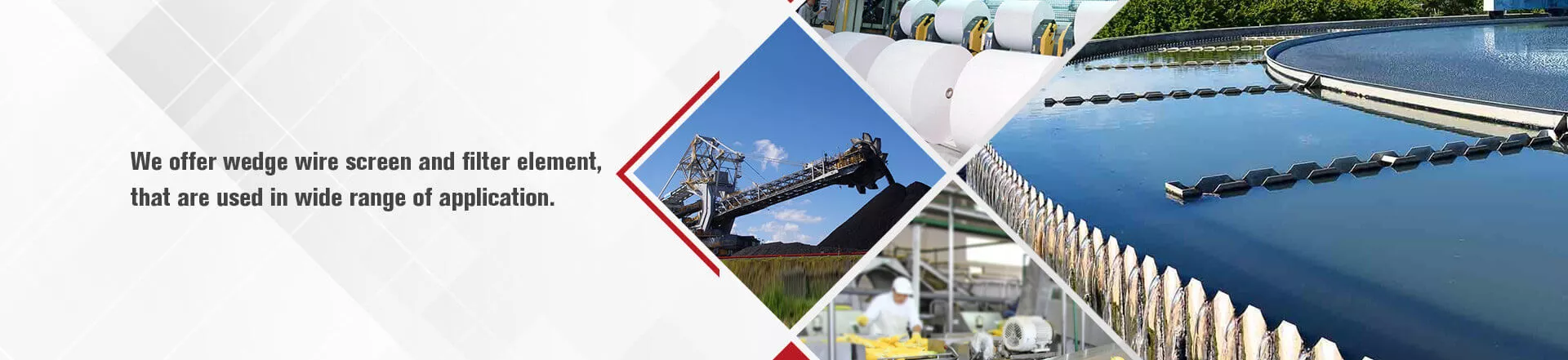
Hydrosieve screens are widely used in:
• Wastewater Treatment
Municipal sewage
Industrial effluent
Related Reading: Hydrosieve Screen for Wastewater Treatment System
• Food Processing
Vegetable washing
Meat processing wastewater
• Pulp & Paper Industry
Fiber recovery
Process water filtration
• Agriculture & Aquaculture
Irrigation systems
Fish farming filtration
• Slot Size
Typical range: 0.25–1.5 mm
Smaller slots = higher filtration precision
Learn more about → Hydrosieve Screens Slot Size Guide
• Flow Capacity
Must match influent volume
Oversizing prevents overflow
• Material Selection
SS304: standard applications
SS316L: corrosion-resistant environments
• Screen Geometry
Curved screens improve separation
Flat screens for compact installations
Design details → Hydrosieve Screen Design Guide
• Screen Clogging
Cause: High organic solids
Solution: Optimize slot size and screen angle
Related Reading: Why Hydrosieve Screens Don't Clog Easily
• Overflow Issues
Cause: Insufficient screen capacity
Solution: Increase screen width or flow area
• Uneven Flow Distribution
Cause: Poor inlet design
Solution: Add a proper distribution system
Learn more details → Common Problems with Hydrosieve Screens (and How to Fix Them)
• Precision wedge wire manufacturing
• Custom slot size and dimensions
• High-strength stainless steel construction
• Reliable performance in industrial applications
Contact us for custom design solutions.
As you investigate filtration systems, it’s important to consider all of your options and take your time making decisions. The filtration system is one of the most important components of an operating system. Consider what type of particles you will be filtering out and what the chemical compatibility of your system is then explore your options to find which system is the best fit for you. If you have any questions during this process, don’t hesitate to reach out. Our Customer Service is happy to help!
Contact us right now at admin@yuanlvfilter.com or WhatsApp: 86-13653285589 to purchase suit your industrial Hydro Sieve filters. Our experienced engineers are ready to help.
What questions do you have?
1. What is a hydrosieve screen?
A hydrosieve screen is a type of static screen that uses wedge wire and gravity flow to separate solids from liquids.
2. How is a hydrosieve screen different from a static screen?
It is a specialized static screen with improved design, higher efficiency, and better clogging resistance.
3. Does a hydrosieve screen require power?
No. It operates using gravity and does not require external energy.
4. What industries use hydrosieve screens?
Wastewater treatment, food processing, pulp & paper, and agriculture.
Reach out to our filtration experts, they will share many options and strategies to help you reach even greater manufacturing productivity and profitability while avoiding common pitfalls, problems and filtration frustrations.
For inquiries, quotes, or require more details on industrial filters or filtration solution