Tel: +86 311 8595 5658 E-mail: admin@yuanlvfilter.com
Choosing the correct slot size for a hydrosieve screen is critical to achieving stable filtration performance.
In most applications, the ideal slot size depends on particle size, flow rate, and the required separation efficiency.
A well-selected slot size improves filtration accuracy, reduces clogging, and ensures long-term operational stability.
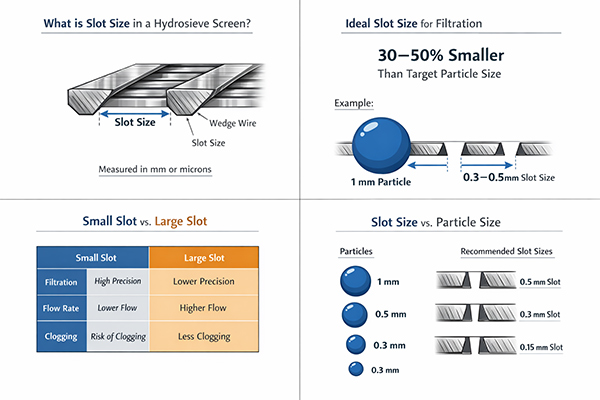
Slot size refers to the width of the opening between wedge wires, typically measured in millimeters (mm) or microns.
In a hydrosieve screen:
The slot controls what particles are retained
It directly determines filtration precision
It influences flow capacity and clogging behavior
In practice, slot size is often called:
• aperture size
• screen opening
• wedge wire spacing
For a complete guide, visit our Hydrosieve Screen Guide
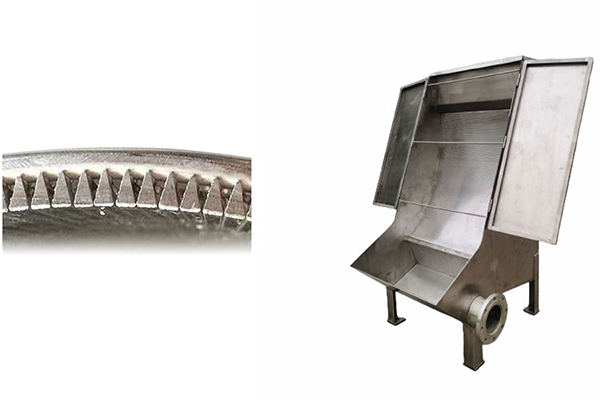
There is no single universal slot size.
The ideal slot size for a hydrosieve screen is typically 30–50% smaller than the target particle size to be removed.
This ensures:
• Effective particle retention
• Reduced solids bypass
• Stable filtration performance
1. Particle Size Distribution
The most important factor is the size of solids in the liquid stream.
• Fine particles → smaller slot size (e.g., 0.25 mm)
• Coarse particles → larger slot size (e.g., 1.0 mm)
Always consider:
• average particle size
• maximum particle size
• particle shape (fibrous vs granular)
2. Flow Rate and Hydraulic Load
Slot size directly affects flow capacity.
• Smaller slots → higher resistance → lower flow rate
• Larger slots → higher flow → lower filtration precision
Balance is required between:
• throughput
• filtration accuracy
3. Filtration Efficiency Requirements
Different applications require different levels of separation:
• High-efficiency filtration → smaller slots
• Pre-treatment screening → larger slots
4. Clogging Risk
Slot size also impacts clogging behavior:
• Too small → increased clogging risk
• Too large → solids pass through
Wedge wire design helps reduce clogging, but slot size must still be optimized.
| Application | Typical Slot Size |
|---|---|
| Municipal wastewater | 0.5 – 1.0 mm |
| Food processing | 0.25 – 0.75 mm |
| Pulp & paper | 0.25 – 0.5 mm |
| Slurry / coarse solids | 0.75 – 1.5 mm |
These values vary depending on process conditions.
Wastewater Treatment Application details → Hydrosieve Screen for Wastewater Treatment System
Understanding the relationship between particle size and slot size is essential.
| Particle Size | Recommended Slot Size |
|---|---|
| 1.0 mm | 0.5 – 0.7 mm |
| 0.5 mm | 0.25 – 0.35 mm |
| 0.3 mm | 0.15 – 0.2 mm |
Slot size should always be smaller than the particles you want to remove.
| Factor | Small Slot Size | Large Slot Size |
|---|---|---|
| Filtration accuracy | High | Lower |
| Flow rate | Lower | Higher |
| Clogging risk | Higher | Lower |
| Maintenance | More frequent | Less frequent |
Selecting slot size is always a trade-off between precision and capacity.
1. Slot Size Too Small
Frequent clogging
Reduced flow rate
Increased maintenance
2. Slot Size Too Large
Poor filtration efficiency
Solids passing through
Reduced system performance
1. Identify particle size distribution
2. Define required filtration efficiency
3. Determine system flow rate
4. Evaluate clogging risk
5. Select trial slot size
6. Optimize based on real operation
Slot size performance also depends on:
• Stainless steel grade (304 and 316L)
• Wedge wire profile
• Manufacturing precision
High-quality wedge wire ensures:
• consistent slot openings
• long service life
Standard slot sizes may not fit all applications.
Custom slot sizes are recommended when:
• solids are irregular
• process conditions are variable
• high precision is required
Choosing the right slot size for a hydrosieve screen requires balancing particle size, flow rate, and filtration efficiency.
In most cases, selecting a slot size slightly smaller than the target particle size ensures optimal performance while minimizing clogging and maintenance.
1. What is the ideal slot size for a hydrosieve screen?
The ideal slot size is typically 30–50% smaller than the target particle size to ensure effective filtration.
2. How does slot size affect filtration efficiency?
Smaller slot sizes improve filtration accuracy but may reduce flow rate and increase clogging risk.
3. What happens if the slot size is too small?
It can lead to clogging, reduced flow capacity, and higher maintenance frequency.
4. Can slot size be customized?
Yes. Custom slot sizes are often used for specific industrial applications with unique particle characteristics.
Design details → Hydrosieve Screen Design Guide