Tel: +86 311 8595 5658 E-mail: admin@yuanlvfilter.com
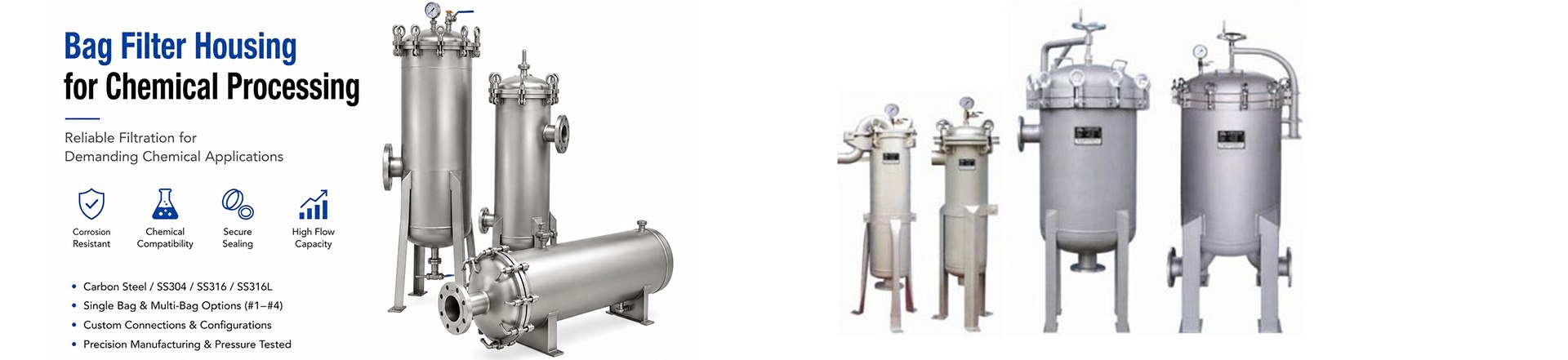
A bag filter housing for chemical processing is a pressure vessel that holds one or more filter bags to remove suspended solids, process debris and other particulate contaminants from chemical liquids. Chemical service requires careful consideration of fluid chemistry, housing material, seals, temperature, pressure, solids loading and filter bag compatibility.
For a complete guide, visit our Industrial Bag Filter Housing Guide.
Bag filter housingsprovide solid-liquid separation to protect process equipment or maintain liquid quality. Depending on the process, they can remove suspended particles, undissolved solids, process debris and, where applicable, catalyst particles.
The filter bag captures solids while the housing supports the bag under operating pressure. When the bag reaches its service limit, it can be removed and replaced without replacing the housing.
Typical duties include filtration of process liquids, chemical solutions, solvents, coatings, oils and other compatible fluids.
1. Chemical Compatibility
The complete wetted system must be compatible with the process fluid. Consider chemical composition, concentration, temperature and operating conditions.
Compatibility should be checked for the housing, filter bag, seals and other wetted parts. A stainless steel housing may be suitable for one chemical service but unsuitable for another.
2. Housing Material
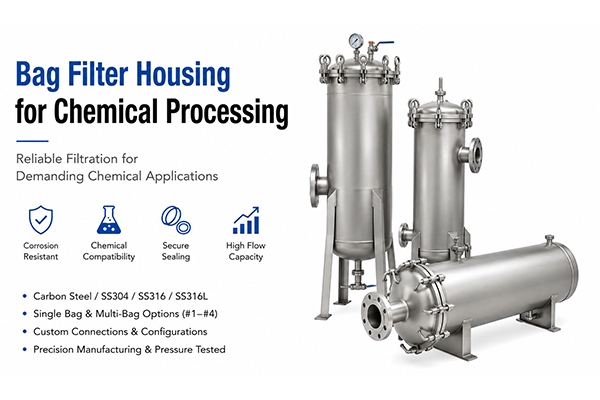
YuanLv Filter bag filter housings are available in carbon steel, SS304, SS316 and SS316L, with customized materials available for specific requirements.
Material selection should be considered together with fluid chemistry, temperature and pressure. SS316L can be considered for demanding applications, but it is not a universal solution for all chemicals. In-depth Reading: bag filter housing material selection
3. Seal and Gasket Material
Chemical compatibility also applies to the sealing system. An incompatible gasket or O-ring can become a weak point even when the housing material is suitable.
YuanLv Filter offers sealing options including nitrile rubber, fluorine rubber and PTFE, depending on configuration. The seal material should match the actual chemical and operating conditions.
4. Flow Rate and Bag Configuration
Single-bag housings suit smaller process streams, batch filtration and compact installations. Multi-bag housings provide greater capacity for higher-flow industrial lines.
YuanLv Filter offers #1, #2, #3 and #4 bag configurations, as well as multi-bag designs. The final configuration should consider flow rate, solids loading, available space and bag change requirements.
5. Temperature and Pressure
Check working pressure, temperature, connection type and sealing materials before selecting the housing. For demanding services, these requirements can be incorporated into a customized configuration.
The filter bag and housing should be selected as one system. Consider:
• Required filtration rating
• Filter media compatibility
• Particle characteristics
• Solids loading
• Operating temperature
• Chemical exposure
• Bag size and configuration
A finer filtration rating is not automatically better. With a high solids load, an unnecessarily fine bag can load quickly and increase replacement frequency. The rating should match the actual separation requirement.
Bag filter housings can be used for:
• Chemical process liquid filtration
• Removal of suspended solids from chemical solutions
• Catalyst particle retention or recovery where suitable
• Paint, coating and ink filtration
• Petrochemical liquid filtration
• Chemical wastewater and process-water pretreatment
The housing and filter bag should be selected according to the specific fluid and process conditions.
Bag filtration is not a universal solution. Applications requiring very fine final polishing, very high solids loading with minimal manual intervention, or continuous automatic solids removal may require another filtration technology.
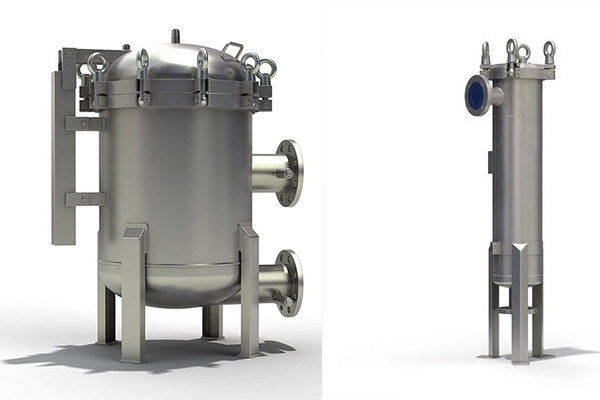
YuanLv Filter manufactures customized bag filter housings for industrial liquid filtration. Standard housing materials include carbon steel, SS304, SS316, and SS316L. Bag quantity and size, inlet and outlet connections, flange standard, sealing material, and installation orientation can be customized.
Manufacturing capabilities include precision welding, CNC machining, pressure vessel fabrication, polishing and passivation, hydrostatic pressure testing and material traceability. Quality checks can include raw material verification, welding inspection, dimensional inspection, pressure testing and final assembly verification.
For a chemical processing project, provide the process fluid, flow rate, operating pressure and temperature, filtration requirement, solids characteristics and preferred connections. These details allow the housing and filtration components to be configured for the actual service.
1. What material is best for a chemical processing bag filter housing?
There is no single material suitable for every chemical. Selection depends on fluid chemistry, concentration, temperature, pressure and all wetted components.
2. Is SS316L suitable for all chemical liquids?
No. SS316L offers useful corrosion resistance, but compatibility depends on the specific chemical and operating conditions.
3. Should I use a single-bag or multi-bag housing?
Single-bag housings suit smaller or batch processes, while multi-bag housings are generally better for higher-flow industrial filtration.
4. What information is needed for a customized housing?
Key information includes process fluid, flow rate, operating pressure and temperature, filtration requirement, solids loading, bag configuration, connections and material requirements.