Tel: +86 311 8595 5658 E-mail: admin@yuanlvfilter.com
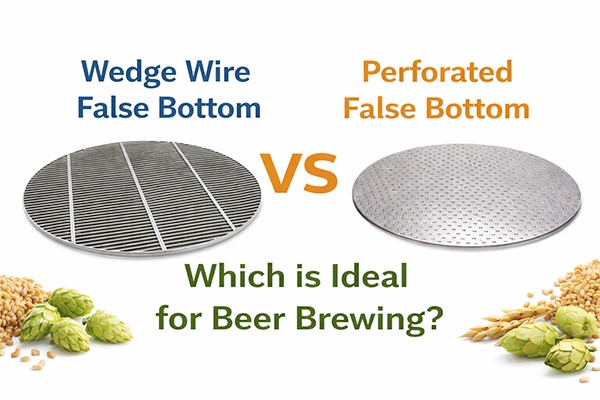
For efficient beer brewing, especially in microbrewery and commercial systems, a wedge wire false bottom is generally superior to a perforated false bottom. It offers higher open area (typically 20–35%), more uniform slot control (0.5–1.5 mm common range), and significantly lower clogging risk due to its V-shaped wire profile.
Perforated false bottoms remain suitable for homebrewing and light-duty systems, but for consistent lautering performance, stable flow rate, and CIP compatibility, wedge wire designs provide measurable operational advantages.
The false bottom in a mash tun performs three critical functions:
• Supports the grain bed
• Separates sweet wort from spent grain
• Controls flow uniformity during runoff
Poor filtration design can lead to:
• Stuck mash
• Channeling
• Reduced extract efficiency
• Inconsistent wort clarity
Construction Principle
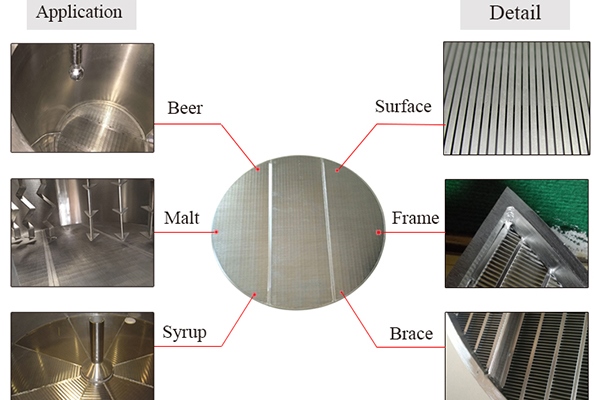
• V-shaped stainless steel profile wire
• Continuous slot structure
• Resistance-welded to support rods
• Precision slot tolerance (±0.05 mm typical manufacturing control)
Common Technical Data (Brewing Applications)
| Parameter | Typical Value |
|---|---|
| Material | SS304, SS316L |
| Slot Opening | 0.5–1.5 mm |
| Open Area | 20–35% |
| Surface Finish | Smooth, non-blinding |
| Structure | Welded rigid panel |
The V-shaped slot widens downward, reducing particle entrapment and improving backflush performance.
Construction Principle
• Flat stainless steel sheet
• Mechanically punched or drilled round holes
Common Technical Data
| Parameter | Typical Value |
|---|---|
| Material | SS304 |
| Hole Diameter | 1.5–3.0 mm |
| Open Area | 10–20% |
| Structure | Flat or slightly domed plate |
| Manufacturing Tolerance | Standard drilling precision |
Perforated designs are structurally simpler but lack the continuous slot geometry that improves hydraulic consistency.
| Performance Factor | Wedge Wire False Bottom | Perforated False Bottom |
|---|---|---|
| Filtration Uniformity | High (continuous slot) | Moderate |
| Open Area | 20–35% | 10–20% |
| Clogging Resistance | Excellent (V-shaped slot) | Moderate to Low |
| Wort Clarity | More consistent | May vary |
| Flow Stability | Uniform distribution | Risk of channeling |
| Load Strength | High (welded supports) | Moderate |
| CIP Compatibility | Excellent | Limited |
| Initial Cost | Higher | Lower |
| Service Life | Long-term industrial grade | Moderate |
Answer: Slot geometry directly influences hydraulic behavior and particle retention.
• V-shaped slots reduce grain bridging.
• Continuous slot length distributes pressure evenly.
• Higher open area lowers differential pressure across the grain bed.
In contrast, round perforations create localized flow concentration, which may increase channeling and uneven extraction.
Breweries that upgrade to wedge wire false bottoms commonly report:
• Improved mash efficiency stability
• Reduced lautering time
• Lower risk of stuck mash in high-adjunct recipes
• More predictable wort clarity
These benefits are most noticeable in:
• High-gravity brewing
• Wheat-heavy or protein-rich grists
• Automated systems using CIP
Frequently Asked Questions
1. Does wedge wire improve mash efficiency?
Yes. By maintaining uniform flow and reducing channeling, extract recovery becomes more stable across batches.
2. Is perforated always inferior?
Not necessarily. For small batch homebrewing, perforated plates are cost-effective and sufficient.
3. What slot size is ideal for brewing?
Most brewing applications use 0.7–1.0 mm slot openings, depending on crush size and grain composition.
4. Is SS316L necessary?
SS304 is common. SS316L is recommended for breweries prioritizing corrosion resistance or operating in aggressive cleaning environments.
Choose Wedge Wire If:
• Brewing volume exceeds 500 L per batch
• CIP cleaning is implemented
• High repeatability is required
• Long-term durability is prioritized
Choose Perforated If:
• Brewing scale is small
• Budget is limited
• Manual cleaning is acceptable
For efficient beer brewing, particularly in professional environments, a wedge wire false bottom provides superior filtration consistency, clog resistance, and operational reliability.
Perforated false bottoms remain practical for small-scale brewing but may introduce limitations in flow stability and long-term performance.
Selecting the correct false bottom should be based on brewing scale, recipe complexity, sanitation requirements, and long-term operational cost.