Tel: +86 311 8595 5658 E-mail: admin@yuanlvfilter.com
Cylindrical centrifuge baskets generally achieve lower final moisture content due to longer solids residence time, while conical centrifuge baskets improve solids discharge and throughput through tapered geometry.
The most efficient dewatering design depends on particle size, solids behavior, and process priorities rather than basket shape alone.
Both basket types are widely used in industrial centrifuges, but their geometry leads to different dewatering and operational outcomes.
For a complete technical guide, visit our → Centrifuge Basket Engineering Guide
A cylindrical centrifuge basket has a constant diameter and straight wall geometry. Solids remain against the basket wall under centrifugal force while liquid passes through the screen or perforations.
Key features
• Uniform centrifugal force distribution
• Stable cake formation
• Longer residence time for solids
• Common in wedge wire and perforated designs
This design prioritizes maximum moisture removal rather than rapid solids transport.
A conical centrifuge basket uses a tapered wall angle to generate axial force in addition to centrifugal force. This helps solids move naturally toward the discharge end.
Key features
• Assisted solids transport
• Faster discharge and higher throughput
• Reduced cake buildup risk
• Common in continuous centrifuge systems
This design prioritizes operational efficiency and discharge reliability.
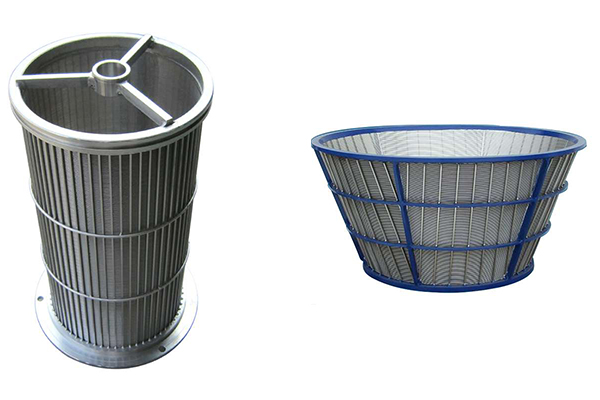
Cylindrical baskets provide:
• Longer exposure of solids to centrifugal force
• More complete liquid drainage
• Better control of cake thickness
As a result, cylindrical centrifuge baskets often achieve lower final moisture content, especially for coarse or free-draining solids such as coal, salt, and minerals.
Conical baskets:
• Reduce solids residence time
• Improve solids flow and discharge
• Minimize clogging and bridging
This leads to slightly higher residual moisture, but improved process stability and throughput, especially with fine or sticky materials.
| Performance Factor | Cylindrical Basket | Conical Basket |
|---|---|---|
| Dewatering efficiency | Higher for coarse solids | Moderate to high |
| Final cake moisture | Lower | Slightly higher |
| Solids residence time | Longer | Shorter |
| Solids discharge | Mechanical assistance | Geometry-assisted |
| Throughput capacity | Moderate | Higher |
| Risk of cake buildup | Higher if poorly matched | Lower |
Neither design is universally superior. Dewatering efficiency depends on process conditions.
Cylindrical baskets are more suitable when:
• Low moisture content is critical
• Solids are granular or coarse
• Feed conditions are stable
Conical baskets are more suitable when:
• Continuous discharge is required
• Solids are fine, sticky, or variable
• High throughput is a priority
In many systems, wedge wire basket construction, slot size, and open area have as much impact on performance as basket geometry.
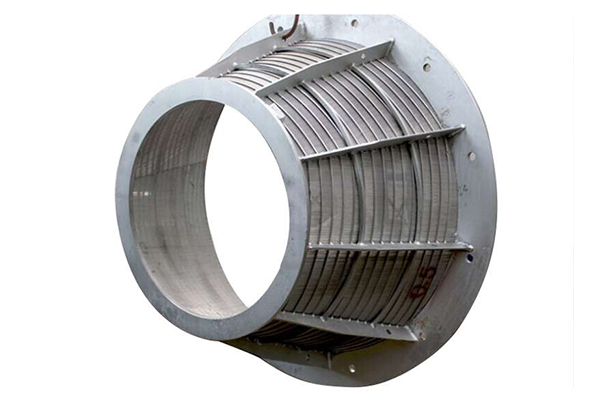
Independent of basket shape, efficiency is affected by:
• Slot size and open area ratio
• Centrifugal G-force
• Basket material (stainless steel, duplex steel)
• Wear resistance and surface finish
• Structural integrity under load
Optimized basket design improves separation efficiency while reducing maintenance and downtime.
Frequently Asked Questions
1. What type of centrifuge basket gives the best dewatering efficiency?
Cylindrical centrifuge baskets typically provide better dewatering efficiency for coarse solids due to longer residence time, while conical baskets trade some dryness for improved discharge and throughput.
2. Why do conical centrifuge baskets discharge solids more easily?
The tapered wall creates an axial force component that naturally moves solids toward the discharge end, reducing cake buildup and improving operational continuity.
3. Does basket shape matter more than slot size?
No. Slot size and open area often have a greater impact on dewatering efficiency than basket shape, especially in wedge wire centrifuge baskets.
4. Are conical baskets better for fine or sticky materials?
Yes. Conical centrifuge baskets are commonly preferred for fine, sticky, or variable solids because they reduce clogging and improve discharge reliability.
5. Can cylindrical and conical baskets use the same materials?
Yes. Both designs are commonly manufactured in stainless steel or duplex steel and can use wedge wire or perforated constructions, depending on application needs.
Cylindrical and conical centrifuge baskets represent two different engineering approaches to dewatering. Cylindrical designs maximize moisture removal, while conical designs enhance solids transport and throughput. Selecting the correct basket requires evaluating material behavior, process goals, and operating conditions, not just basket geometry.