Tel: +86 311 8595 5658 E-mail: admin@yuanlvfilter.com
A hydrosieve screen requires regular inspection, proper cleaning, and correct operating conditions to maintain stable performance. When maintained correctly, it can operate for long periods with minimal downtime due to its simple, gravity-driven design.
This guide explains how to maintain a hydrosieve screen effectively in wastewater treatment and industrial filtration applications.
For a complete guide, visit our Hydrosieve Screen Overview
Hydrosieve screens are known for their low-maintenance operation, but they are not maintenance-free.
Without proper care, issues may develop, such as:
• Reduced filtration efficiency
• Uneven flow distribution
• Surface buildup or partial clogging
• Increased wear over time
Routine maintenance helps ensure consistent performance and extends service life.
Maintenance focuses on three main areas:
• Screen surface condition
• Flow distribution system
• Operating parameters
Each of these directly affects efficiency and reliability.
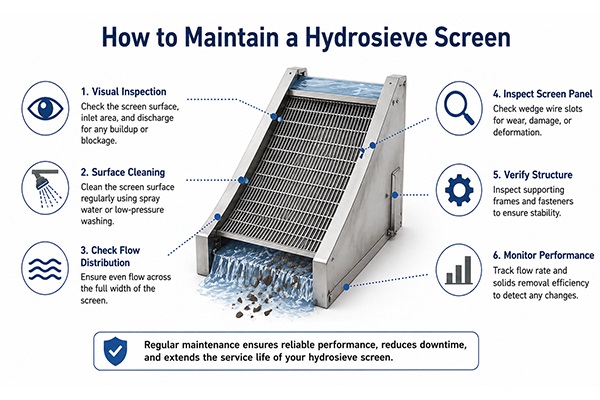
1. Visual Inspection
Check the screen regularly for:
• Accumulated solids on the surface
• Uneven flow patterns
• Signs of damage or deformation
Early detection helps prevent larger operational issues.
2. Surface Cleaning
Although hydrosieve screens are designed to resist clogging, periodic cleaning may still be required.
Common methods:
• Spray water cleaning
• Low-pressure washing
Best practice:
Avoid high-pressure cleaning that could damage wedge wire slots or affect alignment.
3. Check Flow Distribution
Uneven inlet flow is one of the most common causes of reduced performance.
Inspect for:
• Blocked inlet channels
• Improper weir levels
• Uneven liquid spread across the screen
Correcting flow distribution improves efficiency immediately.
1. Inspect Wedge Wire Screen Panel
The wedge wire sieve bend panel is the most critical component.
Check for:
• Wear or abrasion
• Slot deformation
• Corrosion (especially in aggressive environments)
If damage is detected, replacement or repair may be necessary.
2. Verify Structural Integrity
Inspect the frame and support structure:
• Loose fasteners
• Misalignment
• Mechanical stress points
Maintaining structural stability ensures consistent operation.
3. Monitor Performance Indicators
Track key indicators such as:
• Flow rate
• Solids removal efficiency
• Discharge behavior
Changes in performance often indicate underlying maintenance issues.
1. Problem: Partial Clogging
Cause:
Fine slot size, sticky solids, or insufficient cleaning
Solution:
• Adjust slot size (if design allows)
• Increase cleaning frequency
• Improve pre-treatment
2. Problem: Uneven Flow Distribution
Cause:
Improper inlet design or blockage
Solution:
• Clean inlet channels
• Adjust flow distribution system
3. Problem: Reduced Capacity
Cause:
Overloading or buildup on the screen
Solution:
• Verify design capacity
• Clean screen surface
• Optimize flow conditions
In-depth → Common Problems&Solutions with Hydrosieve Screens
Maintenance frequency depends on operating conditions.
General guideline:
• Daily: Visual inspection
• Weekly: Basic cleaning and flow check
• Monthly: Detailed inspection of screen and structure
Systems handling higher solids loads may require more frequent maintenance.
To extend the life and efficiency of a hydrosieve screen:
• Select the correct slot size during design
• Ensure uniform inlet flow distribution
• Avoid overloading beyond design capacity
• Use corrosion-resistant materials when needed
• Implement preventive maintenance schedules
1. Do hydrosieve screens require frequent cleaning?
No, they are designed to minimize clogging, but periodic cleaning is still recommended depending on the application.
2. Can high-pressure washing damage the screen?
Yes. Excessive pressure may damage wedge wire slots or affect alignment. Low-pressure cleaning is preferred.
3. How long does a hydrosieve screen last?
With proper maintenance and correct material selection, hydrosieve screens can operate for many years.
• Hydrosieve screens require simple but regular maintenance
• Cleaning, inspection, and flow control are the main tasks
• Most performance issues can be prevented with routine checks
• Proper maintenance extends service life and ensures efficiency
Maintaining a hydrosieve screen is straightforward due to its simple design, but consistent attention to cleaning, inspection, and operating conditions is essential. By following a structured maintenance approach, operators can ensure reliable performance, reduce downtime, and maximize the lifespan of the system.