Tel: +86 311 8595 5658 E-mail: admin@yuanlvfilter.com
Choosing the right sieve bend screen starts with three questions: What needs to be separated? How much material must the screen handle? What operating conditions will affect screening performance?
Slot opening, feed flow, solids loading and screen width work together to determine whether a screen can meet the process requirements. The correct configuration depends on the material being processed and the intended application, rather than a universal capacity figure.
The main factors in sieve bend screen sizing are:
| Factor | Why It Matters |
| Slot opening | Influences particle passage, solids retention and blinding risk. |
| Feed flow rate | Defines the volume of material the screen must handle. |
| Solids loading | Affects drainage, material distribution and screening performance. |
| Particle characteristics | Shape, size distribution and material properties influence separation. |
| Screen width | Determines the available screening area and must suit the feed conditions. |
| Installation conditions | Available space, inlet arrangement and discharge requirements affect equipment configuration. |
These factors should be assessed together. A screen selected only by nominal flow rate may not perform as expected if the feed contains more solids than anticipated or is distributed unevenly across the screening surface.
The slot opening should match the separation objective and the feed material's characteristics.
A narrower slot can retain smaller particles, but may increase the risk of blinding and require more frequent cleaning under certain conditions. A wider slot allows more material to pass through, but may not retain the solids required by the process.
Particle shape, size distribution, feed consistency and operating conditions also affect actual separation. Slot opening alone does not guarantee a precise particle-size cut.
Before selecting a slot, identify which solids must be retained, what should pass through, and whether the main objective is dewatering or solids separation.
For more details, see our Hydrosieve Screen Slot Size Selection Guide.
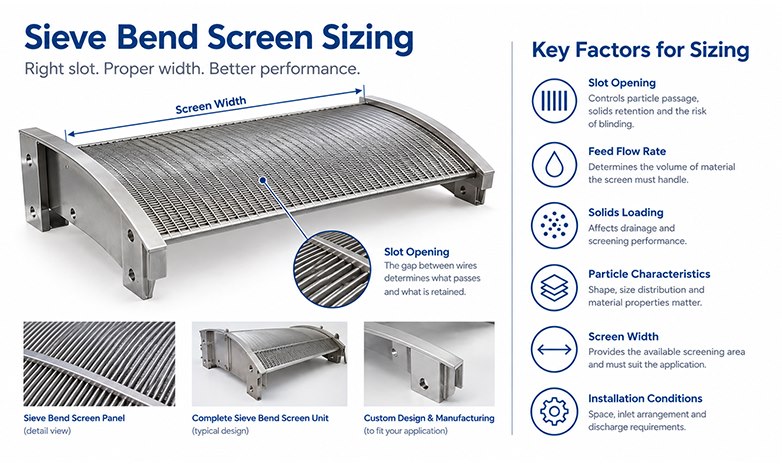
Screen width must be evaluated against feed flow, solids loading, slot opening and the required screening result.
There is no single capacity value that reliably applies to every sieve bend screen. Different materials and operating conditions can produce different results, even when the nominal flow rates are similar.
Feed distribution is equally important. If material enters as a concentrated stream instead of spreading across the screen, part of the available width may remain underused while the loaded section experiences excessive flow.
When assessing screen width, consider normal and peak flow rates, solids concentration, particle characteristics, slot opening, feed distribution and available installation space.
The final dimensions should be selected for the actual application and confirmed through an appropriate manufacturer assessment.
Overflow or poor screening performance does not automatically mean the screen is too small. Check the operating conditions before changing the equipment dimensions.
• Uneven feed distribution: Concentrated flow can overload part of the screen while leaving other areas underused.
• Excessive flow or solids loading: Actual operating conditions may exceed the original requirements and reduce effective screening performance.
• Unsuitable slot opening: The selected opening may not match the material or separation objective.
• Screen blinding or wear: Accumulated solids, fibres or deposits can obstruct openings, while wear can affect separation performance.
• Installation conditions: Inlet head, feed arrangement and discharge conditions can influence material flow across the screen.
The appropriate corrective action depends on the cause. Inspect the feed arrangement and screen condition, and compare actual operating conditions with the original requirements before deciding whether maintenance, adjustment or a different screen configuration is needed.
For a comparison of screening designs, see Hydrosieve vs. Sieve Bend Screen.
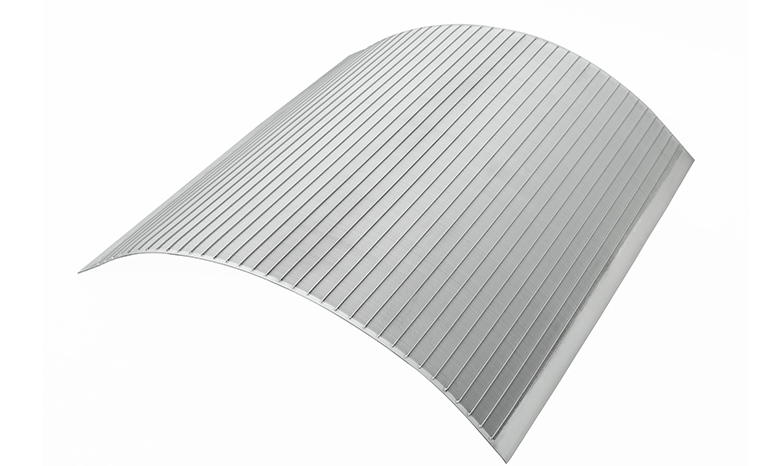
Accurate application details help a manufacturer assess the required screen configuration. Prepare the following information when requesting a quotation:
• Application: Dewatering, solids separation or another screening duty.
• Flow rate: Normal flow, peak flow and operating variations.
• Feed material: Liquid or slurry composition, solids concentration and particle characteristics.
• Separation objective: What needs to be retained or allowed to pass through.
• Slot requirements: Preferred opening, if known.
• Operating conditions: Temperature and other relevant process conditions.
• Installation details: Available space, inlet arrangement and discharge requirements.
• Existing equipment: Drawings, dimensions and details of any performance problems, if applicable.
If some details are unavailable, provide the information you have. The manufacturer can identify what else is needed to evaluate the application.
Standard product information may not cover every process requirement. YuanLv Filter manufactures custom sieve bend screens according to application needs, including slot specifications, screen dimensions and installation requirements.
Our product range includes complete sieve bend screen units, DSM screens and replacement wedge wire screen panels. The appropriate option depends on the screening duty and whether you need new equipment or a replacement component.
Explore our sieve bend screen range or view our wedge wire sieve bend screen plates.
1. Can I replace an existing sieve bend screen panel without replacing the entire unit?
In many cases, a replacement panel may be an option if the existing frame remains suitable. Provide the original drawings or measurements, slot opening, panel profile and fixing details so compatibility can be checked before ordering.
2. Can a custom sieve bend screen fit an existing installation?
Yes. YuanLv Filter manufactures custom sieve bend screens and replacement panels to suit project-specific dimensions, slot requirements and installation arrangements. Existing equipment drawings, connection details and available installation space help establish the required configuration.
3. What is the difference between ordering a complete sieve bend screen and a replacement screen panel?
A complete unit is generally considered for a new installation or an equipment upgrade. A replacement panel is an option when the existing structure can be retained and only the screening surface needs replacement. The appropriate choice depends on the condition of the existing equipment and the requirements of the application.
Need a sieve bend screen for a new installation or replacement project? Contact YuanLv Filter with your process requirements and available equipment details. Our team can review your application and identify a suitable custom screening configuration.
Previous: None