Tel: +86 311 8595 5658 E-mail: admin@yuanlvfilter.com
Selecting the correct slot size is one of the most important factors in centrifuge basket performance. An improperly selected slot opening can reduce dewatering efficiency, increase moisture content, cause fine particle loss, and shorten basket service life.
For a complete technical overview, visit our → Centrifuge Basket Engineering Guide
Slot size refers to the opening width between adjacent wedge wires in a centrifuge basket.
The slot opening determines how solids and liquids are separated during centrifugal dewatering. It directly affects:
• Particle retention
• Liquid drainage efficiency
• Product moisture content
• Throughput capacity
• Separation precision
Slot size is the gap between wedge wires that controls the separation of solids and liquids during centrifugal dewatering.
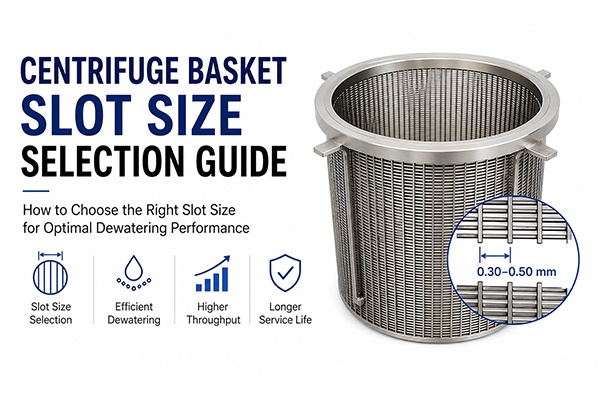
In centrifugal separation systems, slot size controls the balance between moisture reduction and particle retention.
A slot opening that is too small may restrict drainage and reduce throughput, while an oversized slot may allow excessive fine particle loss.
If the Slot Size Is Too Small
Possible issues include:
• Reduced throughput capacity
• Increased clogging risk
• Higher resistance to liquid discharge
• Faster wear under abrasive conditions
If the Slot Size Is Too Large
Possible issues include:
• Fine particle loss
• Reduced product quality
• Lower separation precision
• Unstable dewatering performance
Proper slot size selection is essential for balancing throughput, moisture reduction, and fine particle retention.
Different materials require different slot openings depending on particle size distribution, moisture targets, and operating conditions.
| Application | Recommended Slot Size |
|---|---|
| Fine Coal Recovery | 0.20 – 0.35 mm |
| General Coal Dewatering | 0.30 – 0.50 mm |
| Coarse Coal | 0.40 – 0.50 mm |
| Sand Dewatering | 0.20 – 0.40 mm |
| Sugar Processing | 0.10 – 0.30 mm |
| Mineral Processing | 0.25 – 0.50 mm |
The most commonly used slot size for coal dewatering centrifuge baskets ranges from 0.30 mm to 0.50 mm.
Slot size influences several important aspects of centrifuge basket operation.
1. Smaller Slot Sizes
Smaller slot openings improve particle retention and separation accuracy.
Advantages
• Better retention of fine particles
• Improved separation precision
• Reduced solids loss
Limitations
• Lower throughput
• Higher clogging potential
• Reduced drainage speed
2. Larger Slot Sizes
Larger slot openings improve liquid discharge and flow capacity.
Advantages
• Higher throughput
• Faster drainage
• Lower clogging risk
Limitations
• Increased fine particle loss
• Reduced retention efficiency
Smaller slot openings improve retention, while larger openings increase throughput and drainage efficiency.
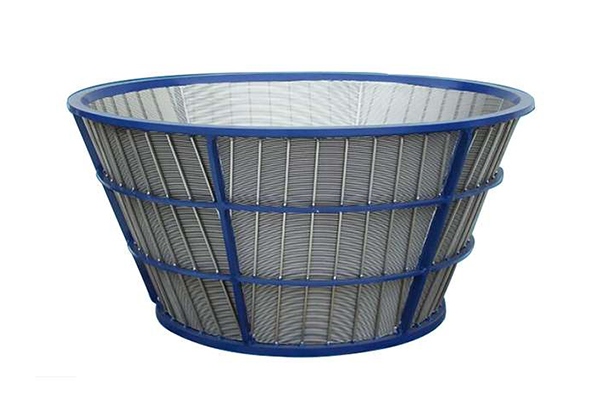
Coal preparation plants commonly use wedge wire centrifuge baskets to reduce the moisture content after coal washing.
The optimal slot size depends on several process conditions:
• Coal particle size distribution
• Desired moisture reduction
• Feed concentration
• Basket rotational speed
• Required throughput capacity
| Coal Type | Recommended Slot Size |
|---|---|
| Fine Coal | 0.20 – 0.35 mm |
| General Coal | 0.30 – 0.50 mm |
| Coarse Coal | 0.40 – 0.50 mm |
Fine coal applications typically require smaller slot openings to reduce fine particle loss.
See Case Study → Coal Dewatering Case Study
Slot size affects how efficiently water can escape during centrifugal rotation.
| Slot Size | Moisture Reduction | Fine Particle Retention |
|---|---|---|
| Smaller Slot | Moderate–High | High |
| Larger Slot | High | Lower |
An optimized slot design should balance:
• Moisture reduction
• Solids recovery
• Throughput efficiency
Open area is closely related to slot size and wedge wire profile design.
Typical effective open area for coal centrifuge baskets ranges from approximately 10% to 18%, depending on structural strength requirements and operating conditions.
Higher open area generally improves:
• Drainage efficiency
• Throughput capacity
• Liquid discharge speed
However, excessive open area may reduce mechanical strength under high rotational loads.
Higher open area improves drainage efficiency but must be balanced with structural stability and wear resistance.
1. Excessive Moisture Content
Possible causes include:
Slot opening too small
Restricted drainage
Basket clogging
2. Fine Particle Loss
Possible causes include:
Oversized slot opening
Poor retention performance
3. Rapid Basket Wear
Possible causes include:
Improper material selection
High abrasive load
Excessive flow velocity
Improper slot size selection can reduce dewatering efficiency and shorten centrifuge basket lifespan.
Slot size should never be selected based on a single parameter alone.
Engineers should evaluate:
• Particle size distribution
• Moisture reduction targets
• Throughput requirements
• Centrifuge operating speed
• Basket diameter
• Abrasion conditions
• Structural load requirements
Wedge wire centrifuge baskets provide more precise slot control than perforated plate designs.
| Feature | Wedge Wire Basket | Perforated Plate |
|---|---|---|
| Slot Precision | High | Moderate |
| Open Area | Higher | Lower |
| Anti-Clogging Performance | Excellent | Moderate |
| Drainage Efficiency | Better | Lower |
| Service Life | Longer | Shorter |
The V-shaped wire profile also creates a self-cleaning effect that helps reduce blockage during operation.
Wedge wire baskets provide more accurate slot control and better anti-clogging performance than perforated plate baskets.
Related Reading → Cylindrical vs Conical Centrifuge Baskets
Practical Recommendations
✔ Match slot size to particle size distribution
✔ Balance retention efficiency and throughput
✔ Use wear-resistant materials in abrasive applications
✔ Monitor moisture performance regularly
✔ Avoid oversizing slot openings for higher flow rates
✔ Select appropriate basket geometry for operating conditions
Frequently Asked Questions
1. What is the standard slot size for coal dewatering?
Most coal dewatering centrifuge baskets use slot sizes between 0.30 mm and 0.50 mm.
2. Does a smaller slot size always improve dewatering?
No. Smaller slot openings improve particle retention but may reduce throughput and increase clogging risk.
3. What slot size is typically used for fine coal?
Fine coal applications commonly use slot openings between 0.20 mm and 0.35 mm.
4. Why are wedge wire centrifuge baskets preferred?
Wedge wire baskets provide:
Higher open area
Better anti-clogging performance
More precise slot control
Longer service life
5. How does open area affect centrifuge basket performance?
Higher open area improves drainage efficiency and throughput capacity, but structural strength must also be maintained.
Slot size is one of the most critical parameters in centrifuge basket design.
The correct slot opening improves:
Dewatering efficiency
Product quality
Throughput performance
Basket service life
For coal processing and industrial dewatering systems, wedge wire centrifuge baskets provide precise slot control, reliable drainage performance, and long-term operational stability.
Proper slot size selection is essential for achieving efficient and stable centrifuge basket performance in industrial dewatering applications.