Tel: +86 311 8595 5658 E-mail: admin@yuanlvfilter.com
Static screens and rotary drum screens both remove suspended solids from industrial wastewater before downstream treatment. The main difference is their screening and cleaning methods.
A static screen uses gravity to separate solids through a stationary screening surface. A rotary drum screen uses a rotating cylindrical screen with mechanical cleaning. The right choice depends on flow conditions, solids characteristics, available hydraulic head and maintenance requirements.
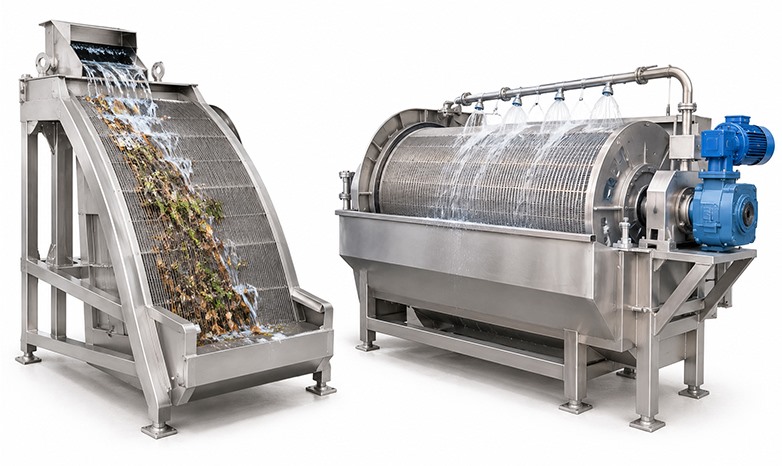
A static screen typically consists of an inlet, a curved wedge wire screening surface, a collection channel and a solids discharge section. Wastewater flows over the screen under gravity. Liquid and smaller particles pass through the slots, while larger solids are retained and move toward the discharge area.
With no motor or drive mechanism, a static screen has a relatively simple structure. Its performance depends on available hydraulic head, flow conditions and solids characteristics.
A rotary drum screen uses a motor-driven rotating cylinder to separate solids from wastewater. Retained material is removed through a cleaning system during operation. This requires a drive mechanism and associated maintenance.
| Comparison | Static Screen | Rotary Drum Screen |
| Screening method | Gravity-driven screening | Rotating cylindrical screen |
| Moving parts | None in the screening zone | Drum and drive system |
| Power demand | No power for screening itself | Requires a motor |
| Hydraulic conditions | Needs suitable inlet head | Depends on feed and installation design |
| Cleaning | Periodic rinsing or manual cleaning | Mechanical or spray cleaning |
| Fibrous solids | May accumulate on the screen | Mechanical cleaning helps manage accumulation |
| Flow variations | Performance depends on available head | Handles variations within its design range |
| Maintenance | Inspection and screen cleaning | Drive, bearings and cleaning components |
| Typical applications | Gravity-fed industrial wastewater and pretreatment | Applications requiring regular mechanical cleaning |
Neither design is suitable for every wastewater condition. A properly sized static screen can work reliably under stable conditions, while a rotary drum screen may be more suitable when continuous mechanical cleaning is required.
1. Flow Rate and Hydraulic Head
Static screens rely on gravity and sufficient hydraulic head to maintain flow across the screening surface. Inlet conditions, installation elevation and approach velocity all affect performance.
Where available head is insufficient or flow conditions fluctuate significantly, a rotary drum screen may be worth considering.
2. Solids Characteristics
Free-draining solids are generally easier to handle on a static screening surface. Long fibres, hair, grease and sticky materials may accumulate and affect screening performance.
A rotary drum screen with a suitable cleaning system can be a better option for applications with these solids.
3. Cleaning and Maintenance
Static screens have fewer mechanical components but still require regular inspection and cleaning. Retained solids must also move freely toward the discharge area.
Rotary drum screens provide mechanical cleaning during operation but require maintenance of the drive and cleaning system.
4. Power and Wash Water Availability
A static screen is suitable for gravity-fed installations where electrical power or wash water is limited.
Rotary drum screens require electrical power, and some designs also need a reliable cleaning-water supply. These requirements should be considered before installation.
5. Downstream Treatment Requirements
The required separation size and acceptable solids carryover should be established before selecting equipment. Screen aperture alone does not determine capacity or performance. Screen area, flow conditions and solids loading also matter.
A static screen is worth considering when:
• Wastewater can flow through the equipment by gravity.
• Inlet head and flow conditions are relatively stable.
• Retained solids can drain and move toward the discharge.
• A simple structure without a drive mechanism is preferred.
• Power and wash-water availability are limited.
Static screens are commonly used in industrial wastewater pretreatment and gravity-fed screening applications.
A rotary drum screen may be more suitable when:
• Fibrous or sticky solids require regular mechanical cleaning.
• Solids accumulate quickly on stationary screening surfaces.
• Flow and solids conditions vary within the equipment's design range.
• Continuous mechanical cleaning is required.
• The site can accommodate the drive and cleaning systems.
The final selection should always consider actual wastewater characteristics and operating conditions.
• Comparing equipment by slot opening alone: The same aperture does not guarantee the same screening capacity. Screen area, flow conditions and cleaning arrangements also affect performance.
• Confusing a screen panel with a complete machine: A curved wedge wire screen panel is a component. A complete static screen also includes the inlet, collection and solids discharge arrangements.
• Ignoring inlet conditions: Available hydraulic head, approach velocity, feed-box geometry and installation layout must be considered when specifying a static screen.
• Providing incomplete wastewater information: Design flow, peak flow, solids characteristics, required separation size and discharge requirements are essential for equipment selection.
1. Is a static screen the same as a sieve bend screen?
A sieve bend screen is a type of curved static screening equipment that uses a wedge wire surface. A complete static screen also includes the inlet, collection and solids discharge sections.
2. Does a rotary drum screen always have a higher capacity?
No. Capacity depends on screen area, aperture, flow rate and solids loading. A properly designed static screen can meet the required capacity under suitable operating conditions.
3. Which screen requires less maintenance?
Static screens have fewer mechanical components and generally require less mechanical maintenance. Rotary drum screens need additional servicing of the drive, bearings and cleaning system.
4. What information is needed to select a suitable screen?
Key details include design and peak flow rates, solids characteristics, required separation size, available hydraulic head and solids discharge requirements.
Previous: None